On the Radar: Kirkus 3/1/15

“On the Radar” is a new feature when I plan to call attention to readers reviewed in major publications.

Kirkus Reviews 3/1/15

kirkus-mar1

Look Out, Mouse! Steve Bjorkman
Good Night, Knight by Betsy Lewin
3, 2, 1, GO! by Emily Arnold McCully
The Cowboy by Hildegard Muller

All four of these titles are from Holiday House’s “I Like to Read” series and received reviews in Kirkus.

kirkus-mar115

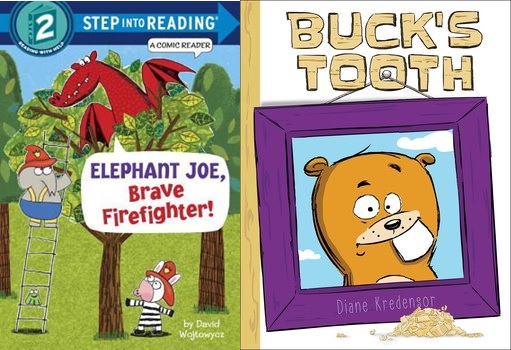
Also reviewed: Elephant Joe, Brave Firefighter by David Wojtowycz which is part of “I Can Read” from HarperCollins.

And lastly, Kirkus listed Buck’s Tooth by Diane Kredensor as an early reader. Simon and Schuester’s website lists it as an “easy-to-read illustrated chapter book” which may or may not be a beginning reader by my library’s standards. It may go into graphic novels or early chapter books.

Review: Splat the Cat & the Hotshot

The Basics

splatthecathotshot
Title: Splat the Cat and the Hotshot
Author: Laura Driscoll (based on the books by Rob Scotton)
ISBN: 9780062294166
Copyright Date: 2015
Publisher: HarperCollins Publishers
Reader Brand: I Can Read!
Level: Level 1 Beginning Reading
Series: Splat the Cat (Splat the Cat Makes Dad Glad, Splat the Cat Up In the Air at the Fair, Splat the Cat Blow Snow Blow, Splat the Cat A Whale of a Tale, Splat the Cat With a Bang and a Clang, Splat the Cat The Rain is a Pain, Splat the Cat The Name of the Game, Splat the Cat Takes the Cake, Splat the Cat and the Duck With No Quack, Splat the Cat Good Night Sleep Tight, Splat the Cat Sings Flat)

Thoughts

Splat the Cat is feeling upstaged when a new friend has all the answers at cat scouts. But when the new cat can’t fix a problem, Splat finds that he had talents of his own! The book’s ultimate message is about teamwork.

As with each book in the series, readers are working on a particular sound — “ot” in this case (Scott/Mott/lot/spot/knot/pot/forgot/hot/apricots/spot/rot/not/swat) — which gives readers time to work on their rhyming words. [Some of those may not rhyme depending on your geographical accent.]

The Splat books are a great “bridging” up book for children who loved the Splat the Cat picture books. They will be thrilled when they are able to read a Splat book all on their own. For me, personally, the Splat books leave me feeling a little underwhelmed (to be fair, the picture books also do). Sometimes the rhymes seem a bit forced and some of the words can be difficult for what I consider a “Level 1” reader to be.

Overall, the series is still hugely popular at my library and I will continue to connect kids to the Splat books and to purchase the readers. Recommended for libraries with cat fanatics or Splat fans.

Series to Know: Cowgirl Kate & Cocoa

Series Info

cowgirlkateandcocoa

Books:

  1. Cowgirl Kate and Cocoa
  2. Cowgirl Kate and Cocoa: Partners
  3. Cowgirl Kate and Cocoa: School Days
  4. Cowgirl Kate and Cocoa: Rain or Shine
  5. Cowgirl Kate and Cocoa: Horse in the House
  6. Cowgirl Kate and Cocoa: Spring Babies

Links: Author Site || Teacher’s Guide

Awards: 2006 Geisel Honor (Cowgirl Kate and Cocoa), 2010 Cybils Finalist (Cowgirl Kate and Cocoa: Spring Babies), 2008 Monarch Nominee (Cowgirl Kate and Cocoa: Partners)

Reviews: School Library Journal, Kirkus Reviews, Horn Book, Library Media Connection

Difficulty

These are definitely your upper-end beginning readers, perfect for the kids developing confidence on their own but still feeling overwhelmed by an early chapter series like Magic Treehouse or Junie B. Jones.

The book feature integrated text and images, short sentences with building vocabulary, and dialogue. The first book has words that are harder and more complex (thirsty was one that stood out to me), as well as a fair amount of ranching terminology (rope, pasture, cowhorse, etc.) which may require a bit more work for readers unfamiliar with horses.

Cowgirl Kate and Cocoa books contain four short chapters, each one tells a complete story. I broke down the first book by chapter: A Story for Cocoa has 101 unique words, The Surprise has 92 unique words, Counting Cows has 101 unique words, and Bedtime in the Barn has 116 unique words.

Every book in the series is available on both Lexile and Accelerated Reader: average of 352L and 2.3AR.

Thoughts

I think this series is a good choice for readers that have moved on from Henry and Mudge or Elephant and Piggie. The difference here is that Kate and Cocoa’s relationship switches from feisty to caregiving; with both cowgirl and cowhorse taking care of the other at one point or another.

The books also work well as a read-aloud, each chapter can be done at a single reading. Bedtime in the Barn would make a particularly timely bedtime story, with the potential to make parents laugh as Cocoa pulls the “I’m hungry”, “I’m thirsty” cards to stay up later.

More Cowgirl Kate and Cocoa?

favstories-cowgirlkate

In the last few years, Houghton Mifflin has re-released some of the Cowgirl Kate and Cocoa stories under their Green Light Readers series. Each “new” book contains two stories from the previously released book. Lexile levels are slightly up at 365L based on 4 books and Accelerated Reader is down slightly with 2.2AR based on 2 books.

Dates to Remember

Nothing that I can see on the horizon, though I hope we haven’t seen the last of this dynamic duo.

On the Radar: Growing Minds March 2015

growingminds-mar15

In this month’s Growing Minds (which is put out by Baker & Taylor and available online, Early Chapter/Beginning Reader starts on pg. 30), I found this plethora of beginning readers! No reviews, just plot summaries.

Amelia Bedelia Is For the Birds by Herman Parish
Biscuit Goes Camping by Alyssa Capucilli
Annie by Thomas Meehan, adapted by Bonnie Bader
Birthday Mice by Bethany Roberts
Bots’ Best Friend by Lucy Rosen
Gideon by Oliver Dunrea
Gideon & Otto by Oliver Dunrea
I Scream for Ice Cream by Rob Scotton
Power Ponies to the Rescue! by Magnolia Belle
Rescue from Jabba’s Palace (Star Wars)
Use the Force! (Star Wars)
Super Secret Surprise Party by Jane O’Connor

Enjoy!

Review: Loud Louie

The Basics

loudlouie
Title: Loud Louie
Author: Sheila Sweeny Higginson
ISBN: 9781423164562
Copyright Date: 2013
Publisher: Disney Press, Disney/Hyperion
Reader Brand: World of Reading
Level: Level Pre-1
Series: Doc McStuffins (All Stuffed Up, Blame It On the Rain, Brave Dragon, Brontosaurus Breath, Caught Blue-Handed, Starry Starry Night)

Thoughts

There are a lot of pluses with a beginning reader series based on a popular franchise. Children are already familiar with phrases (“Toys, go stuffed”) and words/names (Hallie, Stuffy, stethoscope, tweezers). Children are more motivated to read a new story with their favorite character.

There are reasons I really like Doc McStuffins as a franchise. Doc is a girl of color just being a little girl which is important in my diverse community. Doc is also a pioneer of STEAM! She’s using science and solving problems on her own without the help of an adult, although her mother (a doctor) is obviously a role model.

This beginning reader series has rebus pictures embedded in the text. Most of the words substituted are names for characters. I did find it a little bit strange that the word “bed” was one of the rebus words while harder words like telephone were not. (Also, telephone and cell phone were used interchangeably.)

All in all, I felt that this reader was a solid addition to the series. A definite purchase for communities with Doc fans.

Brand: Ready to Read

History

IMG_0785

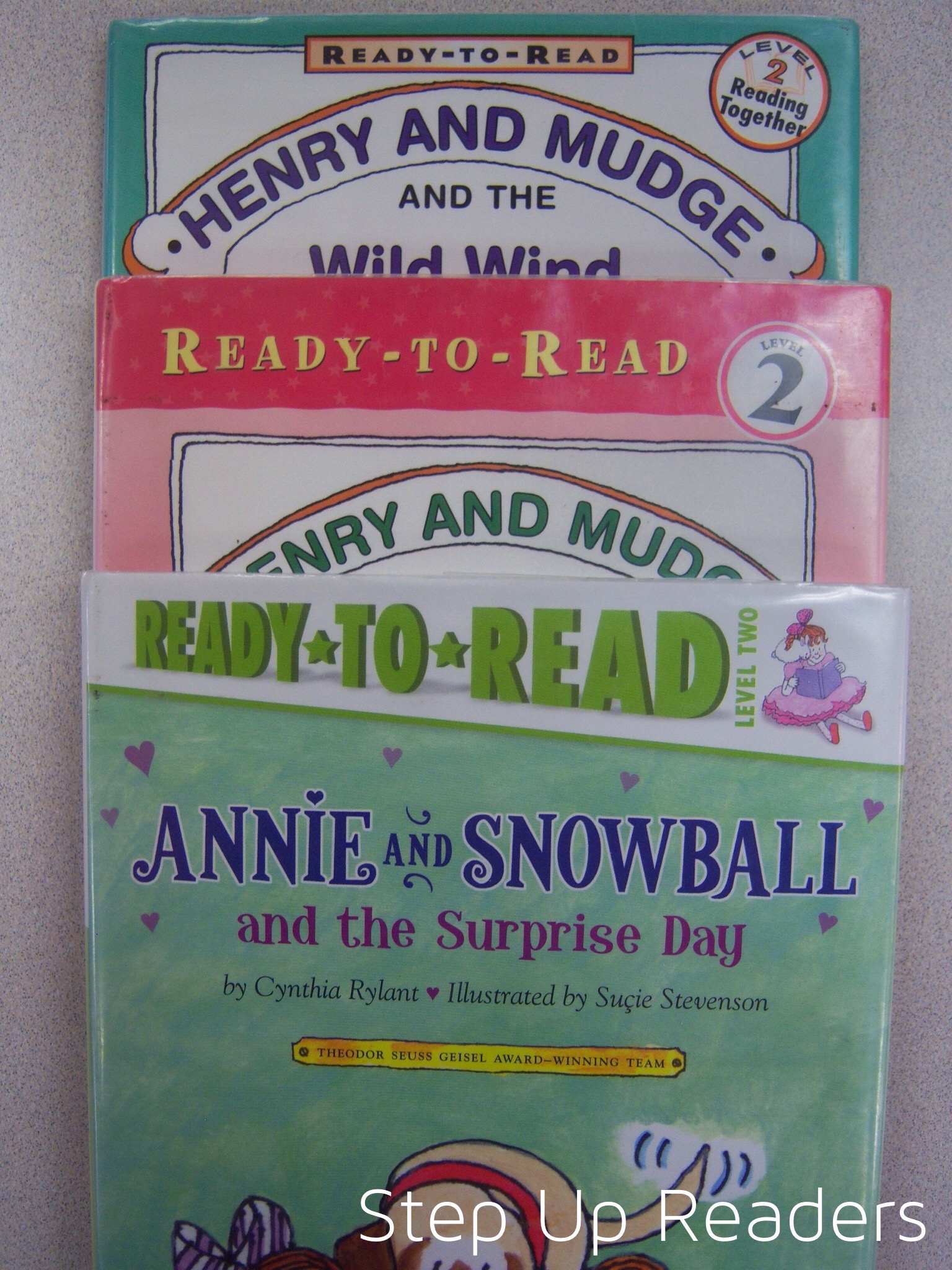
After extension research on Simon and Schuster’s business website and the Ready to Read website, I still have no idea when the brand was created. The very first Henry and Mudge book published in 1987 has the Ready to Read Level 2 on its cover, which is the earliest S&S series that I know of.

[Also, according to my library’s catalog, Macmillan used the term “Ready to Read” prior to 1987, beginning in 1973. This is, of course, incomplete research because it is just based on the 77 libraries’ holdings in our consortium.]

The “Ready to Read” website was created in 2005, according to whois.net.

The most recent re-boot of the “Ready to Read” brand occurred in 2011, with the star levels being introduced.

Leveling

IMG_0784

The are four levels in the “Ready to Read” series.

  • Pre-Level One: Rising Star Reader — Shared reading, familiar characters, simple words
  • Level One: Star Reader — Easy sight words and words to sound out, simple plot and dialogue, familiar topics and themes
  • Level Two: Superstar Reader — Longer sentences, simple chapters, high-interest vocabulary words
  • Level Three: Megastar Reader — Longer & more complex story plots and character development, variety of challenging vocabulary words, more difficult sentence structure

I’m a crazy statistics person, so I went through the Lexile and Accelerated Reader websites to give you an idea of how these programs [that I don’t necessarily agree with][1] compare to the “I Can Read” levels.[2]

Pre-Level One Rising Star Reader:
Daniel Tiger’s Neighborhood series had a 260L and 0.5AR average. [3]
Brownie and Pearl series had a AD140L and 1.0AR average.

Level One Star Reader:
Olivia series had a AD368L and a 1.7AR average.
Katy Duck series had a 415L and a 1.4AR average.

Level Two Superstar Reader:
World of Eric Carle series had a 522L and 3.3AR average. [4]
Henry and Mudge series had a 431L and 2.4AR average.

Level Three Megastar Reader:
History of Fun Stuff series had a NC920L and 5.6AR average. [5]

The only place that Fountas and Pinnell (Guided Reading) appears is in the recommendation app that I’ll write more about later.

Characters and Authors

Familiar Characters Based on Picture Books: Olivia, Trucktown, Eloise, Brownie and Pearl, Katy Duck, Bugs/Bugland (Carter)

Original Series: Twins (Weiss), Inch and Roly, Max & Mo, Robin Hill School, Friday the Scaredy Cat, The Really Rotten Princess

Classics: Eric Carle, Henry and Mudge, Puppy Mudge, Annie and Snowball, Pinky and Rex

Media Tie-Ins: Daniel Tiger’s Neighborhood, Mike the Knight, Rabbids Invasion (Game), How to Train Your Dragon, Kung-Fu Panda, The Smurfs, Yo Gabba Gabba

More Information

My favorite discovery on the “Ready to Read” site is their Assets section which includes certificates, activity guides, and other incentives to help beginning readers. I think this section could be a great help to a ton of librarians looking for activity pages as passive programs.

Another great resource for librarians to be aware of is the App available on the site. By answering a few quick questions (gender, age, grade, Lexile, Guided Reading, and interests) — all of which are able to be skipped — will generate a selection of recommendations for “Ready to Read” books. This is a great place to start if you have absolutely no idea what to recommend, especially if a parent gives you a Lexile or Guided Reading level.

“Ready to Read” also has a Facebook page, but no Twitter or Pinterest as far as I can tell.

I also signed up for both the Parents email listserv and the Educators email listserv. I’m interested in seeing what the difference is between the two. And these actually accepted my work .info email address!

Notes

[1]:
I don’t think that assigning students to read within a certain level based on tests is beneficial. I believe all reading is good reading. That being said, these programs are based on text and sentence difficulty which is useful in trying to standardize reader levels across the various brands.

[2]:
So, I chose the series by looking at which books had the most statistical data available. I eliminated books that were media tie-ins (The Smurfs, Rabbids Invasion, Dreamworks’s Home) and also limited each grouping to a single author. Which means that since I evaluated “Henry and Mudge”, I did not evaluate “Annie and Snowball”.

[3]:
Daniel Tiger’s Neighborhood only had one book available on Lexile — “Thank You Day”, so it’s not a true average.

[4]:
All of the Eric Carle book data was actually taken from the picture book information. Only two readers had information available (“Pancakes, Pancakes” in Lexile & “The Greedy Python” in Accelerated Reader.)

[5]:
The NC in the Lexile means Non-Conforming score. Basically that the score is atypical for the type of material the book is. It was also the only Lexile score available for the series.
Review: Penny and Her Doll

The Basics

pennyandherdoll
Title: Penny and Her Doll
Author: Kevin Henkes
ISBN: 9780062081995
Copyright Date: 2012
Publisher: Greenwillow Books, HarperCollins Publishers
Reader Brand: I Can Read!
Level: Level 1 Beginning Reading
Series: Penny (Penny and Her Marble, Penny and Her Song)

Thoughts

Gram has sent Penny a doll. Penny loves her new doll, but struggles to figure out her new doll’s name.

Penny is great little character (true confessions: I have a stuffed Penny that I love to pieces), and I’m fearful that we may have seen the end of her since Penny and Her Marble was published nearly two years ago.

What works so wonderfully in the Penny series, in my opinion, are Henkes’s illustrations. His mice are so expressive that I even detect a hint of a side-eye from Mama when talk about her favorite weed. (Spoiler alert: Mama does not have a favorite weed.) It’s such a great asset to aide comprehension since the word difficulty is higher.

The book is told in three chapters which makes it more than manageable for a reader to do a chapter a night, or would even work as a family read-aloud. Definitely a recommended purchase for all libraries; please write/publish more Penny books!

Series to Know: Thingy Things

Series Info

The four republished Thingy Things books.

The four republished Thingy Things books.

Books:

  1. Sluggly Slug (2000)
  2. Wormy Worm (2000)
  3. Goosey Goose (2000)
  4. Snaily Snail (2000)
  5. Whaley Whale (2000, 2014)
  6. Lamby Lamb (2000, 2014)
  7. Doggy Dog (2000, 2014)
  8. Moosey Moose (2000, 2014)
  9. Cowy Cow (2014)
  10. Crabby Crab (2014)
  11. Buggy Bug (2014)
  12. Clammy Clam (2014)

Publisher: Originally published by Hyperion (books went out-of-print in 2006); acquired by Abrams Appleseed for redistribution in 2014

Links: Publisher’s Weekly on Abrams Acquiring Thingy Things

Awards: N/A

Reviews: Horn Book (both original and revised editions)

Reader?

So, let’s talk about why I consider these readers instead of picture books (the library world largely agrees with shelving these in picture books, according to my consortium).

The page spreads are ideal for the youngest of beginning readers; the illustration is on the left and the text is on the right. It’s rare to find a picture book that would not utilize both pages at least once in the book. The text is large and fairly easy to read. (It would be easiest on a white background though — point made.)

Words are introduced gradually. I’m thinking particularly of “Lamby Lamb” where Lamby Lamb is told not to put on his pants, shirt, coat, and hat on separate pages. The phrase “Don’t put on your ____” is repeated over and over again with one slight variation of “Don’t remember your umbrella” as the last page of Lamby Lamb getting dressed. While ‘remember’ and ‘umbrella’ are harder words for beginning readers, the illustrations give the context clue for umbrella.

I also think that the trim size of the book gets lost in picture books. I’ve worked at a library with spine-out shelving and and a library with face-out bin shelving. These books (also Peter Rabbit & the Mr. Men and Little Miss books) get hidden behind the more standard sized picture books. In readers though, this trim size is just perfect for kids to hold on their own.

Finally, these aren’t daunting in the least. They are easily worked through in one sitting, with or without an adult’s help depending on the reader. It’s why I think they are ideal beginning readers.

Difficulty

I already discussed a lot of what I would normally say in difficulty under the first section, so this one will mostly be hard statistics.

“Lamby Lamb” has 22 unique words and is only 24 pages long. The other books are similar: “Whaley Whale” has 17 unique words. “Crabby Crab” has 31 unique words and “Clammy Clam” has only six!

None of the books have been Lexiled, but three of them do have AR tests. The range of AR difficulty is between 0.7-1.1.

Thoughts

What resonates so much for me with these books are their spot-on child humor. Doggy Dog doesn’t know what he is — a cat or a lampshade? Whaley Whale is hiding in plain sight. Lamby Lamb falls victim to reverse psychology and gets ready. Sluggy Slug does not want to move and loves saying NO!

I’m so ridiculously glad that Abrams has brought these little gems back in-print. And I think a thousand more libraries need to order them so that we can get the last four re-printed and maybe even more at the article above mentions is a possibility.

Dates to Remember

None at the moment. I am hoping that Abrams will re-release the last four previously released titles. I’ll keep you posted if I hear word of it!

On the Radar: Kirkus 2/15/15

“On the Radar” is a new feature when I plan to call attention to readers reviewed in major publications.

Kirkus Reviews 2/15/15

kirkus-feb15

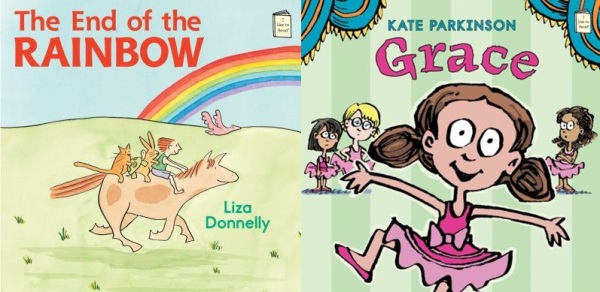
The End of the Rainbow by Liza Donnelly
Grace by Kate Parkinson

Both of the titles from Holiday House’s I Like to Read series were given full reviews in the issue.

kirkuscs-feb15

Spring Cleaning by Dori Chaconas (Cork & Fuzz #10) was mentioned in the Continuing Series portion; no review.


Review: Meet the Dinotrux

The Basics

meetthedinotrux
Title: Meet the Dinotrux
Author: Chris Gall
ISBN: 9780316400640
Copyright Date: 2015
Publisher: Little Brown and Company, Hachette Books
Reader Brand: Passport to Reading
Level: Level 1 Reading Together
Series: Dinotrux (Dinotrux Go to School)

Thoughts

The Dinotrux world (originally picture) has expanded to begin to include beginning readers! This second volume follows all the Dinotrux as they band together to create a bridge to visit one another. Dinosaurs and transportation — do I need to say anything more to get preschool boys to pick this series up?

At the beginning of the book, a “Guide to the Dinotrux” is printed that includes both pictures and phonetic pronunciations of the Dinotrux. This is great for beginning readers to work on sounding on the Dinotrux’s names even though fans of the picture books will likely be familiar with how they are pronounced. The text is definitely large enough for readers to feel comfortable. Most of the text is above the pictures, on a white background and I think that will also help beginning readers.

The storyline is fairly predictable, which is perfect for this age group. But I’m still going to agree with Passport to Reading‘s assessment that this book is a beginning reader best shared with an older sibling or parent. Recommended.