Series to Know: Elephant & Piggie

Series Info

The first five books in the “Elephant and Piggie” series.

Books:

  1. Today I Will Fly! (2007)
  2. My Friend Is Sad (2007)
  3. I Am Invited to a Party! (2007)
  4. There Is a Bird On Your Head (2007)
  5. I Love My New Toy (2008)
  6. I Will Surprise My Friend (2008)
  7. Are You Ready to Play Outside? (2008)
  8. Watch Me Throw the Ball (2009)
  9. Elephants Cannot Dance (2009)
  10. Pigs Make Me Sneeze (2009)
  11. I Am Going! (2010)
  12. Can I Play Too? (2010)
  13. We Are In a Book! (2010)
  14. I Broke My Trunk! (2011)
  15. Should I Share My Ice Cream? (2011)
  16. Happy Pig Day! (2011)
  17. Listen to My Trumpet (2012)
  18. Let’s Go for a Drive (2012)
  19. A Big Guy Took My Ball (2013)
  20. I’m a Frog! (2013)
  21. My New Friends Is So Fun (2014)
  22. Waiting Is Not Easy! (2014)

Publisher: Disney Hyperion

Links: Pigeon Presents Elephant & Piggie [2013 Party Kit] || World of Elephant & Piggie [Kit] || Author Site

Awards: 2008 Geisel Medal (for There Is a Bird On Your Head), 2009 Medal (for Are You Ready to Play Outside?), 2011 Geisel Honor (for We Are In a Book!), 2012 Geisel Honor (for I Broke My Trunk!), 2013 Geisel Honor (for Let’s Go For a Drive), 2014 Geisel Honor (for A Big Guy Took My Ball), 2015 Geisel Honor (for Waiting Is Not Easy!), 2009 Monarch Nominee (for Today I Will Fly!), 2013 Monarch Nominee & Second-Place Award (for We Are In A Book!), 2008 Cybils Award (for I Love My New Toy & 2008 Cybils Finalist (for I Will Surprise My Friend!), 2009 Cybils Award (for Watch Me Throw the Ball!), 2010 Cybils Award (for We Are In a Book!), 2011 Cybils Award (for I Broke My Trunk!), 2013 Cybils Finalist (for A Big Guy Took My Ball!), 2014 Cybils Finalist (for My New Friend Is So Fun!)

Reviews: Horn Book, Publishers Weekly, School Library Journal, Library Media Connection Reviews

Difficulty

Elephant & Piggie is one of the first series you should point beginning readers to. Stories are easy to understand through Willems’s expressive illustrations. One of my favorite ways the books help children to understand dialogue is that Gerald(Elephant)’s words are always in a gray speech bubble while Piggie’s are always in pink. When other characters are introduced, each character has their own colored speech bubble as well.

The series builds vocabulary as it goes on. In Today I Will Fly!, readers first learn “fly” and then “flew” and “flying” later on in the story. I think this is particularly helpful for beginning readers who might be struggling to understand past/present tenses.

The first Elephant and Piggie book, Today I Will Fly! has 41 unique words while the most recent, Waiting Is Not Easy! has 72 unique words. As with every series, the range of unique words and difficulty level can fluctuate, so I’ve provided the Lexile range and Accelerated Reader ranges. Series range for Lexile: 0(BR)-240 and Accelerated Reader: 0.5-1.3.

[This is a case where I feel that Lexile & AR may be doing beginning readers a great disservice by having such low ranges. A lot of beginning readers may test out of the ranges far before they are ready to leave Piggie and Gerald behind.]

Thoughts

I feel like this is a case where I cannot be unbiased. Elephant and Piggie feel like dear friends to me after I’ve seen how the kids at both of my libraries adore them.

The humor in these books is funny to both children and adults. I have seen a room of kids crack up at “Banana!” in We Are In a Book! when just a few hours ago the librarians were in stitches practicing our reader’s theater version of the same scene. (And speaking of reader’s theater — if you’ve never done these books as a reader’s theater piece, you are missing out. We just read Waiting Is Not Easy as a form of stress relief during our last department meeting because we’re changing our ILS.)

As with all series, I know that other readers have felt like some of the sparkle of Elephant and Piggie may be leaving. I, personally, do not feel that way. I thought for a brief moment that Waiting Is Not Easy might have become my new favorite this past month, but I still think the joy of “Banana” cannot be topped.

Dates to Remember

I Will Take A Nap! — the next installment in the series — will be out on 6.2.15! Mark your calendars now!

Review: Drop It, Rocket

The Basics

dropitrocket
Title: Drop It, Rocket
Author: Tad Hills
ISBN: 9780385372473
Copyright Date: 2014
Publisher: Schwartz & Wade Books, Penguin Random House
Reader Brand: Step Into Reading
Level: Level 1 Ready to Read
Series: Rocket (Rocket’s 100th Day of School)

Thoughts

Rocket is learning new words to add to his word tree, but what happens when he doesn’t want to drop the red boot?

There are two repeating sections in this book that make it a good beginning reader. An excerpt of the first repetitive section:

Rocket finds a leaf. “Drop it, Rocket,” says the bird. Rocket drops the leaf. He is a good dog.”

And continues with other objects. The second repetitive section is as such:

“Will you drop it for a stick?” asks Emma. Rocket will not drop it.

These repetitive sections are great for building a reader’s confidence since the sentences are repeated with only slight variations. The sentence length is good for the most part, but a few sentence top over 10 words, which might make for some difficulty in reading. There aren’t too many compound words, mostly names like Emma and Rocket. The layout and font size work well for beginning readers, with more than enough support from the illustrations to give context clues.

Rocket is a great character who loves books. This beginning reader series is a natural extension of what began in How Rocket Learned to Read and it’s great for readers to learn along with Rocket.

I’m not sure how many readers will naturally find Rocket beginning readers on their own though since the original Rocket picture books are too long to work in most preschool storytimes. But that’s why it’s the librarian’s job to get these Rocket readers into kids’ hands. And then to give them the picture books when they want more and more, which is what I think will happen!

Brand: I Can Read!

History

The “I Can Read” brand began in 1957 with the publication of Else Holmelund Minarik’s Little Bear. For over fifty years, the “I Can Read” brand has published favorite friends and series from Amelia Bedelia to Pete the Cat.

Kathleen T. Horning writes in From Cover to Cover: Evaluating and Reviewing Children’s Books:

While Seuss set the standard for excellence in writing, the “I Can Read” series set the standard for form. Recognizing that children learning to read are anxious to feel like “big kids,” Harper designed the books in their beginning reader series to look like skinny chapter books rather than picture book.

Leveling

“I Can Read” brand has six levels. The newest level — My VERY First — was created in 2014.

  • My VERY First — Basic features of print and reading, short and simple sentences, and full-color stories for children at the very first stages of learning to read.
  • Shared My First Reading — Basic language, word repetition, and whimsical illustrations, ideal for sharing with your emergent reader.
  • Level 1 Beginning Reading — Short sentences, familiar words, and simple concepts for children eager to read on their own.
  • Level 2 Reading With Help — Engaging stories, longer sentences, and language play for developing readers who still need some help.
  • Level 3 Reading Alone — Complex plots, challenging vocabulary, and high-interest topics for the independent reader.
  • Level 4 Advanced Reading — Short paragraphs, chapters, and exciting themes for the perfect bridge to chapter books.

I’m a crazy statistics person, so I went through the Lexile and Accelerated Reader websites to give you an idea of how these programs [that I don’t necessarily agree with][1] compare to the “I Can Read” levels.[2]

Shared My First Reading:
Biscuit series had a 162L and 0.95AR average.
Pete the Cat series had a 192L and 1.4AR average.

Level 1 Beginning Reading:
Fancy Nancy series had a 315L and a 2.03AR average.
Splat the Cat series had a 398L and a 2.1AR average. [3]

Level 2 Reading With Help:
Amelia Bedelia series had a 364L and a 2.44AR average.
Flat Stanley series had a 376L and a 2.4AR average.

Level 3 Reading Alone:
Minnie and Moo series had a 378L and a 2.22AR average. [4]

Level 4 Advanced Reading:
Dinosaur Hunter had a 470L and 3.0AR score.

Lastly, I did not compare any guided reading levels (Fountas and Pinnell) since I do not have a subscription. But! “I Can Read” actually has a search by Guided Reading Levels available on their website, which is hugely helpful!

Characters and Authors

Screenshot of some of the “I Can Read” characters.

Familiar Characters Based on Picture Books: Amelia Bedelia (Young), Berenstain Bears, Biscuit, Diary of a Worm, Duck at the Door, Everything Goes (Brian Biggs), Fancy Nancy, Flat Stanley, Little Critter, Pete the Cat, Pinkalicious, and Splat the Cat.

Original Series: Axel the Truck, Charlie the Ranch Dog, Digger the Dinosaur, Dixie, The High-Rise Private Eyes, Huff and Puff, Mac and Cheese, Mia, Minnie and Moo, Mittens, Penny, Pony Scouts, Tug and Pup

Classics: Arthur (Hoban), Danny and the Dinosaur, Frances (Hoban), Frog and Toad, Little Bear, Prelutsky poetry collections

Comic Books: Batman Classic, Justice League Classic, Man of Steel, Superman Classic, Wonder Woman Classic

Media Tie-Ins: Alvin and the Chipmunks, Epic, Ice Age, Marley, Paddington, Plants Vs. Zombies, Rio 2, Walking With Dinosaurs

More Information

One of my favorite things that I discovered on the “I Can Read” site is in the Parents/Educators area — there’s a blog! There’s a fair amount of content here, including classroom resources and other tips for parents of beginning readers. The blog was just started in June of 2014 and it seems to be updated at least once a month.

“I Can Read” also has a great social media presence on Facebook and Twitter. They also have a Pinterest account, but it hasn’t been updated in a year. (Not that I can blame them — Pinterest is a trap!)

I also signed up for the “I Can Read” newsletter, but I had to sign up with my gmail account since it wouldn’t accept my work address as a valid email. (It is a little weird — it’s a .info extension.)

Notes

[1]:
I don’t think that assigning students to read within a certain level based on tests is beneficial. I believe all reading is good reading. That being said, these programs are based on text and sentence difficulty which is useful in trying to standardize reader levels across the various brands.

[2]:
The series chosen to evaluate were based on the series that “I Can Read” promotes on their levels page. For Level 3 & Level 4, there are no promoted series. Level 3 features two series: Minnie and Moo and the Jack Prelutsky poetry collections. Since no Lexile scores were available for the Prelutsky books (I KNOW, RIGHT?!), I chose to evaluate Minnie and Moo. Level 4 has only six books, so I just evaluated the first book as my sample size.

[3]:
Many of the Splat readers were Adult-Directed Lexile scores. I did not use those titles in the averages of the Lexile score.

[3]:
Some Minnie and Moo books were not labeled as Level Three readers, so I did not add those to the averages.

Series to Know: Fly Guy

Series Info

First five “Fly Guy” books.

Books:

  1. Hi! Fly Guy (2005)
  2. Super Fly Guy (2006)
  3. Shoo Fly Guy (2006)
  4. There Was An Old Lady Who Swallowed Fly Guy (2007)
  5. Fly High, Fly Guy (2008)
  6. Hooray for Fly Guy (2008)
  7. I Spy Fly Guy! (2009)
  8. Fly Guy Meets Fly Girl(2010)
  9. Buzz Boy and Fly Guy(2010)
  10. Fly Guy Vs. the Flyswatter (2011)
  11. Ride, Fly Guy, Ride! (2012)
  12. There’s a Fly Guy In My Soup (2012)
  13. Fly Guy and Frankenfly (2013)
  14. Fly Guy’s Amazing Tricks (2014)

Publisher: Scholastic

Links: Parents Resource Guide || Author Website

Awards: 2006 Geisel Honor (for Hi, Fly Guy!), 2010 Geisel Honor (for I Spy Fly Guy), 2008 Cybils Finalist (for Fly Girl Meets Fly Girl), 2008 Monarch Nominee (for Hi, Fly Guy).

Reviews: Publisher’s Weekly, Kirkus, School Library Journal, Bulletin

Difficulty

Hi! Fly Guy is divided into three chapters. No more than four simple sentences are on each page. For example:

They met. The boy caught the fly in a jar. “A pet!” he said.

The text does a good job on building the reader’s knowledge. By the end of the book, most words have already been introduced so when the text does get longer, the reader will have already seen most of the words before. There are just over 100 unique words used in the text. Extra words in the illustrations bring the count to 113 unique words.

The rest of the series follows suit. Some books build on previous knowledg: There Was an Old Lady Who Swallowed Fly Guy definitely works best for readers if they are familiar with the song while Buzz Boy and Fly Guy will be most appreciated by readers familiar with graphic novels/comics.

As with every series, the range of unique words and difficulty level can fluctuate, so I’ve provided the Lexile range and Accelerated Reader ranges. Series range for Lexile: 170-420 and Accelerated Reader: 1.3-2.1.

Thoughts

The adventures of Fly Guy and Buzz begin when Buzz is looking for a pet and finds Fly Guy. Once Fly Guy proves to The Amazing Pet Show judges that he is indeed a pet, Buzz and Fly Guy’s friendship is cemented. Their adventures take them to lots of places and new situations, but at its core, the Fly Guy series is about friendship.

While this series definitely has a male main character, I think that the series will absolutely be accessible for all kinds of readers. The shiny, pretty covers are definitely eye-catching and the content will keep readers coming back for more.

More Fly Guy?

flyguypresentsFly Guy has produced two spin-off series so far. The first is a non-fiction reader series which follows Buzz and Fly Guy as they learn about different non-fiction topics.

In Fly Guy Presents: Sharks, they visit an aquarium. Photography is well utilized and difficult vocabulary words have phonetic pronunciation guides embedded in the text. Readers already familiar with Fly Guy will definitely want to “grow up” with these non-fiction books.

Books:

  1. Fly Guy Presents: Sharks (2013)
  2. Fly Guy Presents: Space (2013)
  3. Fly Guy Presents: Dinosaurs (2014)
  4. Fly Guy Presents: Firefighters (2014)
  5. Fly Guy Presents: Insects (2015)

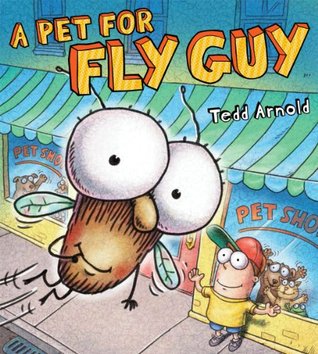
apetforflyguyAnd in 2014, Fly Guy also got a picture book treatment, even though he started as a reader first. I actually haven’t had the chance to re-read this one myself since it has seriously been checked out consistently since we purchased it. I’m glad that readers that connect with Fly Guy in the picture book arena will find him again in beginning readers.

Dates to Remember

Fly Guy Presents Bats (Fly Guy Presents #6) will be arriving on June 30, 2015!

Prince Fly Guy (Fly Guy #15) will be arriving on August 30, 2015!

Launch!

Welcome to Step Up Readers!

This whole project began when I realized how little beginning readers were covered in most major review publications and journals. In the last Kirkus that I read, only one beginning reader was listed and it was in the continuing series portion — it didn’t actually have a review!

The more I thought about it, the more I felt that I was not doing a good job of knowing the beginning readers as well as I do picture books. (Personally, I know YA better than beginning readers! But that’s all going to change with this blog!)

There’s also a lot of maintenance that I need to do with my library’s beginning reader collection. Just in going through the very first “Series to Know”, I discovered that we were missing five volumes that had been published between the time that the previous Early Literacy Librarian had left (November) and when I was able to order (May).

Our themed beginning reader booklists need to be updated; the section needs to be weeded; and obviously I need to make sure we aren’t missing any other gaps in series.

I also want to work on thinking about beginning readers critically since it’s my dream to one day serve on the Geisel Award. And the only way to do that is to start reading and writing out my thoughts.

So, join me on this beginning reader journey. I’ll be back tomorrow with the very first “Series to Know” installment, then a publisher break-down on Wednesday, and a review on Thursday to cap off the first week.