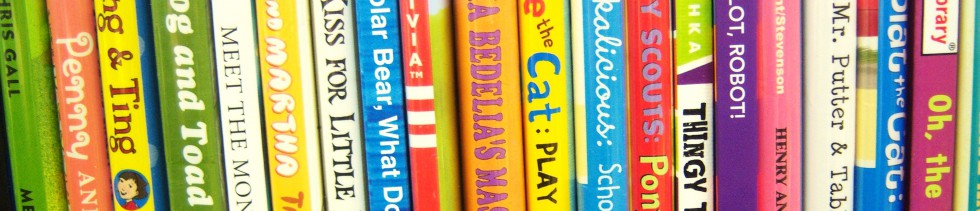
“On the Radar” is a new feature when I plan to call attention to readers reviewed in major publications.
Kirkus 8/1/15
A very small offering of just one beginning reader in this issue:

I Can Help! by Peggy Perry Anderson
“On the Radar” is a new feature when I plan to call attention to readers reviewed in major publications.
A very small offering of just one beginning reader in this issue:
I Can Help! by Peggy Perry Anderson
This feature reviews books, articles, websites, or other resources that discuss beginning readers.
Taking a pause from my reviews of the recommended Geisel Award reading to put a spotlight on a recent article in Children & Libraries — the journal of the Association for Library Service to Children.
Carole D. Fiore and Carla Morris. Children & Libraries. Vol. 13, Number 1, Spring 2015.
The article provides first a brief summary of the Geisel Award thus far. It it a wonderful resource to have small snippets about each winner and a list of the honors, as well as quotes from many of the Geisel committee chairs and even some of the authors!
My absolute favorite part of the article broke down the statistics of the Geisel Award: how many picture books or early chapter books were honored versus the traditional beginning readers. Did you know that the Geisel Award has even honored non-fiction books and graphic novels? To see the full break-down of statistics (including what seems to capture the interest of beginning readers: animal stories, friendship stories, etc.), check out the article!
The last main portion of the article talks about the impact on both authors and committee members. Here’s the part of the article that you may need a tissue for if you’re anything like me. I love reading about the experiences and impacts of an award committee.
The article’s final conclusion talks about the future of the Geisel Award.
What an amazing article to have! This is the ultimate primer about what the Geisel Award is all about without reading the award committee manual. Make sure to keep your eyes peeled for this one — it’s for everyone!

Title: How to Defend Your Dragon
Author: adapted by Ellie O’Ryan
ISBN: 9781481437110
Copyright Date: 2015
Publisher: Simon & Schuster
Reader Brand: Ready to Read
Level: Level 2
Series: Dreamworks Dragons (All About the Dragons, Dragon Mountain Adventure, How to Build a Dragon Fort (upcoming 2/23/16), How to Pick a Dragon, How to Raise Three Dragons (upcoming 9/29/15), How to Start a Dragon Academy)
The village of Berk thinks that Thor is mad at Toothless the dragon for living with them after a series of storms threaten their safety. Will Hiccup be able to save his friend?
If that summary made absolutely no sense to you, no worries. It will make sense to your young patrons though! I don’t know about you, but “How to Train Your Dragon” the movie and subsequent television show is doing nothing but gaining popularity at my library. I did a bit of research to help review this title. It’s based off one of the television episodes, so while the words may be harder than very easy readers, kids familiar with the franchise will have no problems reading the names of their favorite characters and maybe even remembering the episode for extra reading help.
It’s hard to judge media tie-ins against traditional beginning readers because their existence and success depends on the success of another medium (television, movies, games, etc.). If your library has large amounts of “How to Train Your Dragon” fans then I would say go for this title. If not, you can probably skip it. I think it would be too difficult for most readers without that background knowledge.
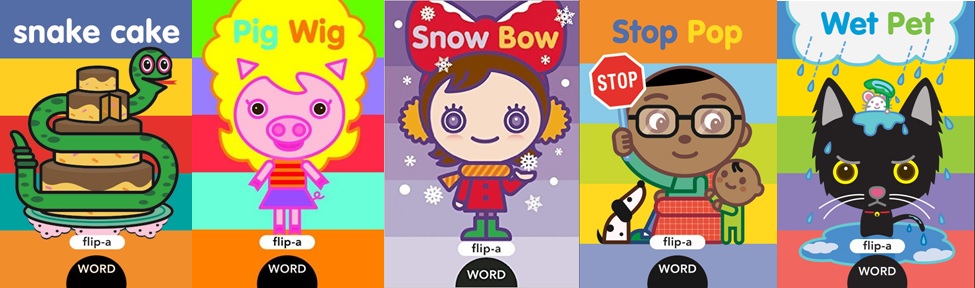
The first five Flip-a-Word readers!
Books:
Links: Blue Apple Books
Reviews: Horn Book, School Library Journal
A rather bizarre section to write this time because I did not find a single Accelerated Reader, Lexile, or Fountas & Pinnell level for any of these books. All of the books have very few words, between 20-35 unique words in the text. There are supplemental word lists and an activity page for kids to practice identifying sight words after the story, which I did not count in the unique word count.
These are the easiest of easy books for beginning readers. Flip-a-Word books are the ones that I give parents looking for those first readers for their kids.
Each book covers three different word families. There’s a reference page at the beginning of each book that encourages parents about how to help their children experiment with the different word family sounds — to create new words and sound combinations.
The graphic illustrations are eye-catching and clearly illustrate what is going on in the picture. It’s a great help to the kids working through their sounds and words.
It’s been over a year since a title was released. Without a dedicated website for the series or author, it’s hard to tell what the future of this series is. My only recommendation is snap these titles up as soon as possible! Your patrons will thank you!
“On the Radar” is a new feature when I plan to call attention to readers reviewed in major publications.

Flop to the Top! by Eleanor Davis & Drew Weing (graphic early reader)
Pig Is Big on Books by Douglas Florian
Cat Got a Lot by Steve Henry
Hiding Dinosaurs by Dan Moynihan
Crow Made a Friend by Margaret Peot
And in the continuing series section…

Prince Fly Guy by Tedd Arnold
Katie Fry Private Eye: The Missing Fox by Katherine Cox
“On the Radar” is a new feature when I plan to call attention to readers reviewed in major publications.
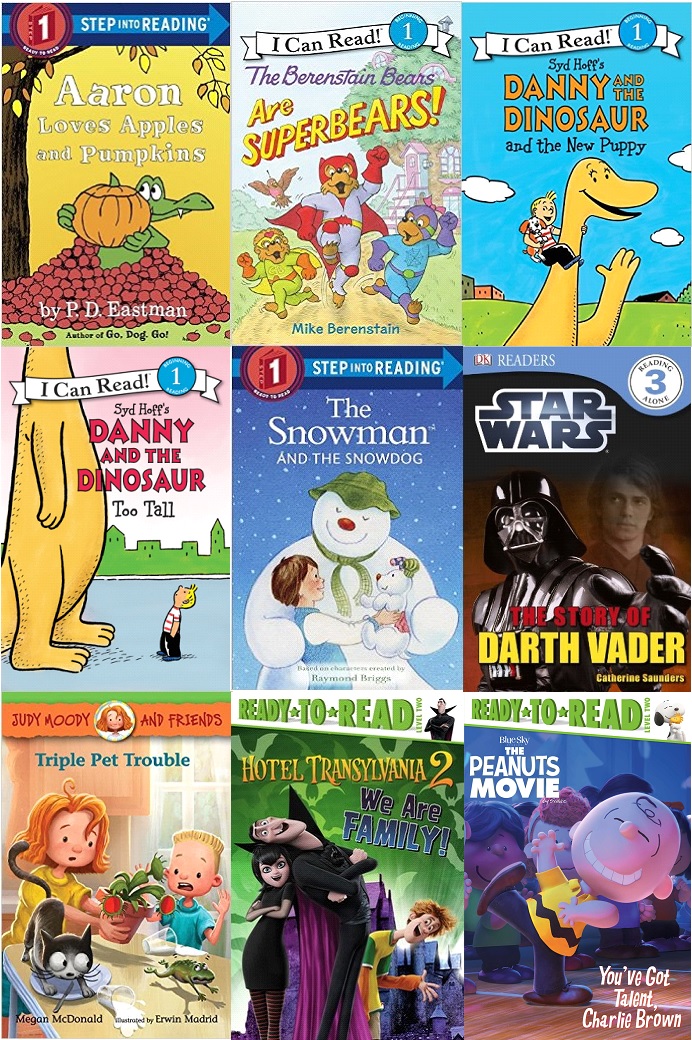
Aaron Loves Apples and Pumpkins by P.D. Eastman
The Berenstain Bears are Superbears! by Mike Berenstain
Danny and the Dinosaur and the New Puppy by Syd Hoff
Danny and the Dinosaur: Too Tall by Syd Hoff
The Snowman and the Snowdog by Raymond Briggs
The Story of Darth Vader by Catherine Saunders (DK)
Triple Pet Trouble by Megan McDonald
We Are Family!: Hotel Transylvania by Sheila Sweeny Higginson
The Peanuts Movie by Charles M. Schulz
This feature reviews books, articles, websites, or other resources that discuss beginning readers.
I’m starting with some of the recommended reading from the Geisel Award Committee Manual.
Tana Elias. Friends of the CCBC Newsletter. Accessed: June 3, 2015.
This article is an interview with Margaret Jensen who held workshops in the lat 1990s about books for beginning readers.
I thought this article was a valuable resource for people curious about evaluating beginning readers. I learned a lot of important things about beginning reader’s eye development. According to Jensen, beginning readers can only see about four letters at a time; two letters to the left and one to two letters to the right. This put the necessity for smaller words in beginning readers into immediate context to me. Smaller words are easier to *see*, not necessarily to sound out. I also learned about what kind of text lay-out is preferred and approximately how much white space should be in and around words.
Jensen also discusses how children learn words — “sight vocabulary” is the term she uses for the words that children memorize vocabulary. This may explain why children often say a completely unrelated word to what they are reading, but it may begin with the same letter as the word they are struggling with.
Also included in this article/interview: additional reading recommendations and advice for parents & librarians.
A great read for anyone looking to further their study with beginning reader texts.
“On the Radar” is a new feature when I plan to call attention to readers reviewed in major publications.
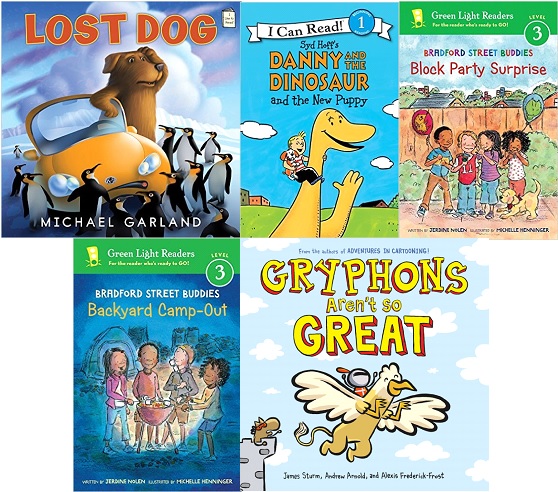
Lost Dog by Michael Garland
Danny and the Dinosaur and the New Puppy by Bruce Hale
Block Party Surprise by Jerdine Nolen
Backyard Camp-Out by Jerdine Nolen
Gryphons Aren’t So Great by James Strum, Andrew Arnold, & Alexis Frederick-Frost (graphic early reader)
This feature reviews books, articles, websites, or other resources that discuss beginning readers.
I’m starting with some of the recommended reading from the Geisel Award Committee Manual.
Ilene Cooper. Booklist, 2004. Accessed: June 3, 2015.
This article is a round-up of ten titles reviewed in Booklist between July 2003 and June 2004. The selections include both fiction and non-fiction, with a variety of publishers and houses represented. It’s a great time capsule of the year and can be used to help build a core collection of beginning readers. The reviews of each book are simple and straight-forward making this a quick article for librarians to read and gain information from.

Title: I Will Take a Nap!
Author: Mo Willems
ISBN: 9781484716304
Copyright Date: 2015
Publisher: Disney Hyperion
Reader Brand: N/A
Level: N/A
Series: Elephant and Piggie
Gerald wants to take a nap, but Piggie keeps interrupting his nap! Will this tired and cranky elephant ever be able to fall asleep and get his nap?
This is the first Elephant and Piggie that felt a bit like a reach to me. I thought the set-up of the joke and twist was fine until the twist was revealed. Piggie having a floating turnip head to prove that Gerald was dreaming the whole time was a bit too much for me. And this might me being a stodgy old adult. I haven’t had a chance to read this in front of a proper test audience. Turnip heads might result in hysterical child laughter. I don’t know yet!
I did think that the green background helped provide context clues to readers that Gerald was dreaming. I was wondering if the average child would know what a turnip looked like and whether or not that would be a difficult word for the kids. Otherwise, the words are just on par for what a beginning reader is looking for. As always, the uncluttered background is wonderful for readers just learning to decode words and the pictures provide enough support to the text.
 Step Up Readers